
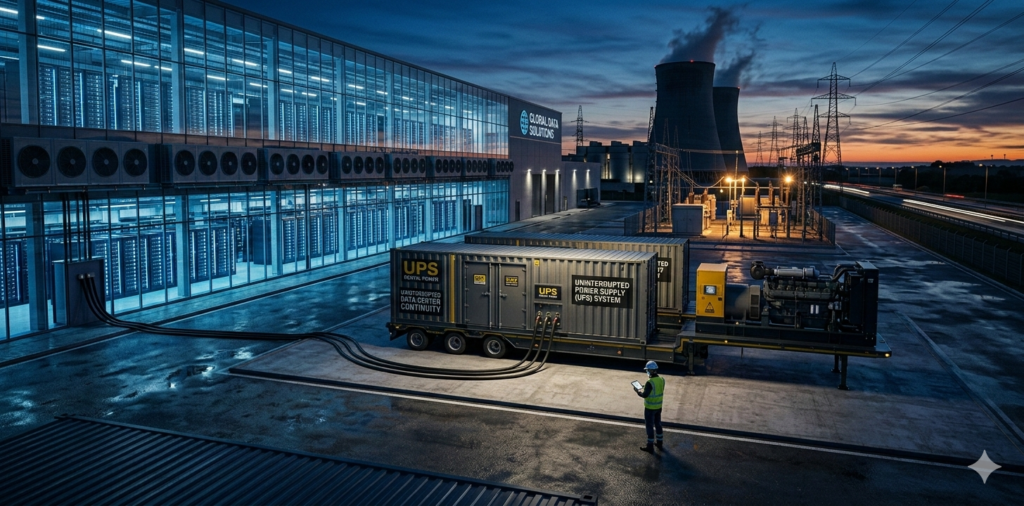
Why Data Warehouses and Storage Facilities Need Uninterrupted Power Supply on Rent
Nowadays, warehouses serve more than simply being a storage space; they’re utilizing technology in many different functions, including:
Tracking inventory items with an inventory system (or an approximation of their inventory); applying scanner technology to scan barcodes on the inventory; applying scanners to the inventory items as they’re transferred into and out of the warehouse; processing product shipments; and using an order processing system (ERP) to create and manage orders.
Because of the way these systems utilize electricity, any type of power interruption—such as a power outage—would adversely affect the operations of the warehouse.
On any given day, if a power outage occurs in a warehouse facility, the following will happen:
This means that the warehouse will not receive or ship any product; there will be no records or inventory statuses created; therefore, nobody at the warehouse can process their orders or update their records.
Thus, there will be significant delays in product shipment, and there will also be errors in inventory management systems.
To prevent any of the aforementioned problems from occurring, a warehouse should have a dependable source of electrical power. It is essential that warehouse facilities utilize a reliable UPS rental for their storage facility operations.
Warehouse Operations Need To Be Power Supply-Aware
Today, the majority of warehouses are utilizing digital inventory systems (as opposed to manual inventory systems).
Digital inventory systems are very common within the warehouse environment and connect to:
If the electrical power to the warehouse is abruptly interrupted for any reason (e.g., power outage, brownout, blackout, etc.), then all servers and computers will immediately stop functioning without warning.
When this happens, the following will occur:
When you’re operating a large warehouse with thousands of products, it may take a while to sort out any disruptions caused by an electrical energy disruptions.
The best way to ensure your warehouse operations are not disrupted due to electrical energy supply issues is to have a dependable back-up power supply in place.A data warehouse UPS will keep systems operational until the main power is restored or until the generators start.
They provide data protection and maintain continuity of operation.
Temperature and Cooling Systems Require Power
Many facilities that hold goods rely on their temperature-controlled systems for refrigeration; they include:
- Pharmaceutical storage facilities
- Food storage locations
- Chemical storage units
- Cold storage warehouses
Temperature-controlled refrigeration systems maintain a constant, proper temperature in order to preserve the value of perishable inventory.
When there is a loss of electrical power, the refrigerator system will fail immediately.
As a result, the temperature begins to rise within the facility.
This creates potential damages to vulnerable products, including food and toys that must remain at controlled temperatures.
Having backup power (UPS) at the warehouse ensures that the refrigeration system continues to operate during a loss of power.
This helps avoid any potential damages to the valuable inventory located at the facility.
Security Systems Need To Remain Operational
Storage facilities house valuable products.
Security systems help to protect the products.
Examples of security systems for warehouses include:
CCTV Video Camera Systems
Access Control Systems
Intruder Alarm Systems
Digital Access Control Entry Logs
Due to failure of power to a security system, the majority of them will stop functioning.
This creates risk exposure for the goods stored in the facility.
By having a UPS available for a storage facility, security systems will continue operating during a power outage.
This ensures that security monitoring will not be interrupted, and valuables will remain safe while the facility has no electrical power.
How UPS Protect Warehouse Infrastructure
UPS systems provide instantaneous backup power.
When the utility electric supply fails, a UPS system starts in battery mode, with the transition occurring in milliseconds.
This ensures that equipment will not experience sudden failure.A UPS for data warehouses protects many systems, such as the following:
- Printing systems
- Barcode reader systems
- Server racks
- Lights
- Security cameras
- Temperature control devices
The UPS will provide enough backup power for an adequate amount of time until the utility power is restored or a generator is started.
The UPS allows operations to continue without interruption.
Renting a UPS Instead of Buying One
A large UPS purchase for data warehouse operations requires a very high investment.
In addition to purchasing items such as:
- UPS Equipment
- Battery Banks
- Infrastructure to Install the Equipment
Companies will incur additional costs for maintenance and battery replacement over time.
UPS rentals for data warehouse operations are often a better option for many companies.
With a rental service, companies are provided with ready-to-use UPS systems, which avoids an up-front expense.
The benefits of renting a UPS instead of purchasing one include:
- Lower initial investment
- Included maintenance
- Technical support assistance
- Easy upgrading of systems
With the above mentioned benefits, companies can concentrate on warehouse operations without having to manage the UPS equipment.
Available Power Solutions to Meet Varying Power Needs of Different Warehouse Types
Warehouses can differ greatly in size and in their respective power requirements.
For example, small warehousing facilities would require only moderate power back-up, while larger logistics businesses would require larger systems.
UPS rental companies provide scalable solutions from which to choose.
Some typical rental capacity designs which are available to rental customers:
- 1. 10 kVA for small warehouse operations
- 2. 20 kVA to 60 kVA for medium warehouses
- 3. 100 kVA to 200 kVA for large logistics warehouse systems
- 4. 300 kVA to 500 kVA for major distribution center systems
Selecting the appropriate capacity for storage facility operations by way of a UPS rental solution is simple for businesses.
If the business expands its warehouse size, the UPS systems will also be easily upgraded to support the greater electrical demands.
Dependable Operations in the Modern Logistic Industry
The modern logistics industry is designed to move goods quickly.
Because of the e-commerce business model, warehouses are typically expected to process new orders every minute.
When operations can no longer be completed due to a loss of electrical power in the warehouse, the capacity of the order processing systems within the warehouse will be greatly deteriorated.
- • Delayed delivery schedules
- • Declining customer satisfaction
The continuity of operations within the warehouse can be ensured when there is an adequate power back-up (UPS) system.
Final Thought
Data warehousing and storage operations have become heavily dependant on the use of electricity to power the most sophisticated types of electrical systems used in today’s world.
Therefore, a loss of electrical power to the warehouse can completely disable the operations (U/I/DC) of many critical components of a warehouse, e.g. Inventory management systems, the ability to keep the equipment and materials cool in the warehouse (Cooling), and provide the necessary security of equipment and materials in the warehouse.
A dependable UPS system to support a datacenter or warehouse can provide the necessary financial benefits to the company as follows:
Avoid purchasing equipment and having to make monthly investments to obtain the equipment.
The most popular types of UPS systems rental companies rent are those that consist of the following capacity ranges 10 kVA to 500 kVA.
Because rentals provide companies with flexible and reliable forms of power back-up for data center or warehouse operations.
Maintaining stable sources of electrical power is important when it comes to maintaining continuous warehousing operations and protecting valuable inventory from unforeseen and catastrophic interruptions.